
Developmental Toys for Babies from 1 to 12 Months
How to choose toys during your baby’s first year, taking into account their age, vision development, and gradually emerging skills.
Angelina Sazonova · 7/16/2026

About the author
Angelina Sazonova
Pediatrician, lactation consultant, and deputy chief physician at Baby Plus Medical Center
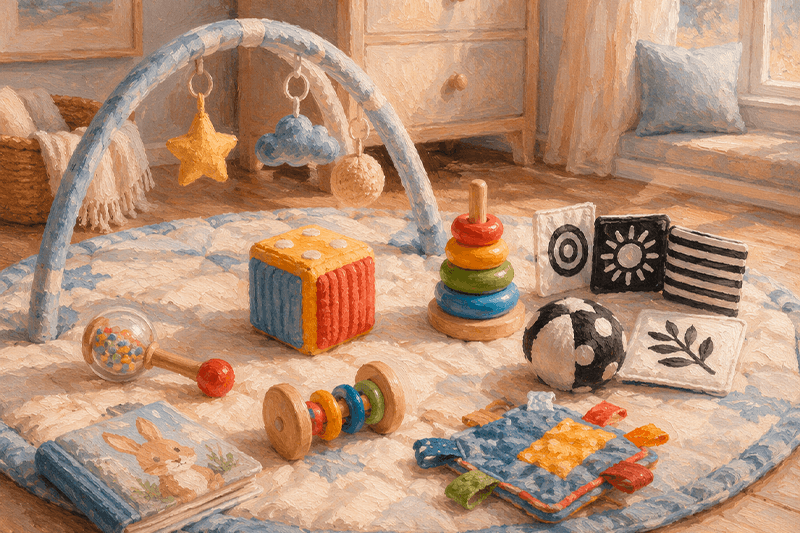
I often see beautifully styled photos online: babies surrounded by toys perfectly matched to the nursery, the stroller, or their outfit, usually in trendy pastel shades like beige, soft pink, milky white, or olive. Pinterest and all that 😌
But it is worth remembering that in the first year of life, the main role of toys is development.
So which toys can support your baby’s development while also meeting our very natural parental wish to care and choose thoughtfully?
Let’s break it down 🌸
Newborn: up to 1 month
- At this age, babies respond best to high-contrast black-and-white images.
- High-contrast pictures help a baby focus their attention.
You can use black-and-white visual cards to encourage focus. If your baby tends to turn their head mostly to one side, place the cards on the opposite side. The baby’s gaze will catch on the contrast, gently encouraging them to turn their head toward the pictures 😉
1–2 months
- At this age, babies begin to notice bright red and yellow colors and respond to sound. That is why bright rattles tend to attract attention better.
- You can play with a toy by moving it to the right, left, up, and down so the baby follows it with their eyes and practices visual tracking.
- Baby mobiles should be bright. Babies at this stage do not yet distinguish pastel shades well. A moving musical mobile can also be used.
Parents can observe whether the baby reacts to the music even when the mobile itself is not moving.
3–4 months
- By this age, the physiological tone in the arms gradually decreases, and the baby starts to grasp objects more intentionally.
- You can place the baby on an activity mat with toys hanging from arches so they reach for them and touch them.
- Remember: toys should be bright and high-contrast, preferably in yellow and red shades.
- Bead-style rattles or ring rattles can also be useful.
4–5 months
- The baby can already see red, yellow, green, and blue, so choose bright toys.
- Vibrating hanging toys can work well because they catch the baby’s attention.
- The baby begins transferring toys from one hand to the other.
6–8 months
- At 6–8 months, babies become interested in squeaky toys, crinkly toys, buttons, moving parts, and sound effects.
- The baby is already learning cause and effect: press a button and music plays; drop a toy and it makes a sound on the floor.
- Blocks help the baby learn to build a tower.
- Board books for babies have many pictures. The baby looks at them, learns to turn pages, and touches images that catch their interest. At this age, the baby is not yet listening to a book as a full story.
9–12 months
- Rattles, stacking rings, blocks, and musical toys with buttons.
- Nesting dolls, stacking cups, and other toys that let the baby place one object inside another.
- Wheeled toys, toy animals, cars, and dolls.
- Picture books and listening to short fairy tales.
- Busy boards.
- Large 4-piece puzzles.
11–12 months
- A set of wooden or plastic plates or cups in different colors that the baby can nest inside one another.
- A simple box where the baby can put toys in and take them out again.
Key takeaway
The main point I want to emphasize is choosing bright toys with the physiology of infant vision in mind. Babies in the first year simply do not perceive pastel colors the way we might wish they did for beautiful social media reels. Please keep this in mind 🥰
The most important thing is our children’s health.